Oil & gas

URS has been a leader in the oil and gas industry for more than 80 years, providing integrated planning, environmental, engineering, construction and operating support services across the entire oil and gas value chain. Services include upstream exploration and production (both on-shore and off-shore) to treatment, transportation, storage (including terminals and underground storage of gas), LNG, refining and marketing. Our long-term clients include most of the world’s largest integrated oil and gas companies, which we support through multi-year, multi-service master agreements. We also provide demolition, asset recovery and integrated property reuse and redevelopment services for sites, including service stations, refineries and former oil fields.

We view each of our customers as a business partner - not just a series of projects. Our fundamental approach to problem solving is guided by the awareness that safety is first and foremost in all of our activities, and that each of our clients has a unique set of concerns and objectives. We offer a consistent global approach and innovative solutions to the complex technical, scientific and management issues affecting the full Oil & Gas value chain.

URS’ combination of broad industry experience and local knowledge helps clients solve key exploration and production issues across environmental, social, economic and engineering fields, navigate complex regulatory negotiations, and effectively engage stakeholders to ensure smooth and on-time project completion. We provide construction, construction management, procurement and installation services, as well as commissioning, start-up and testing support. Where appropriate, we partner our clients to add value to their business by providing on-site engineering support, dedicated long-term operations and maintenance and expert troubleshooting and turnaround assistance.

We have worked for virtually all major oil and gas companies, on the majority of refineries, storage / distribution terminals and service station networks in Western Europe, as well as on privatisation projects for state-owned oil companies and due diligence, corporate audit, soil and groundwater investigation / remediation and regulatory compliance / permitting in Europe, the Middle East, Africa and the Americas.

A Primer on Reserve Growth

This post was originally written by Rembrandt in 2006.
Will 730 billion barrels be added to the reserve pool from reserve growth between 1996 and 2025 as estimated by the United States Geological Survey?
This post is the third part in a three piece series about the phenomenon of reserve growth in found oil fields. Insight in future reserve growth, often attributed to technological advancement, is crucial in determining the peak of conventional oil production. Parts 1 and 2 can be found here and here.
What we learned in part 2 of this series is that the data with respect to reserve growth is utterly confusing. Nonetheless, we need an answer to the question what the future perspectives are for reserve growth in order to; 1) improve forecasting the peak in conventional oil production; 2) Increase the understanding of the future role of technology in the oil industry.

The United States Geological Survey has so far been the only institute which has published an estimate for future reserve growth.

In their World Petroleum Assessment from the year 2000 they estimated that reserves would grow with 730 billion barrels between 1996 and 2025.(612 billion barrels for conventional oil, 118 billion barrels for Natural Gas Liquids). By estimating past reserve growth in the US lower 48 a reserve growth algorithm was established. This algorithm of which the curve is shown below was then applied to the entire world. Delivering an estimate of 730 billion barrels.

Chart 1 - Source: USGS, Verma
The problem with this method is the way how crude oil reserves are reported in the US which has been described in detail in part 2. Because of the practice of reporting only proven reserves, the amount of reserve growth is very high in the US when compared to other regions. In addition several heavy/extra heavy oil fields such as the kern river oil field are included in the assessment, which showed huge reserve growth due to the advancement in steam technology necessary to dilute the oil to produce it in the middle of the 20th century. It is erroneous to apply reserve growth in such heavy/extra heavy oil fields with medium and light crude oil fields.
Thirdly applying onshore reserve growth to offshore and deepsea fields is certainly not an approach that gives a correct estimate. Based on these three issues, the figures presented by the USGS do not seem to have much value. The method used likely provides figures too inacurrate to be relied upon.
However, the USGS authors (Albrandt et al) have acknowledge a part of the problems outlined:
"There are several reasons why a reserve-growth function that is based on historical trends for oil and gas fields in the Lower 48 states could Overestimate world potential reserve growth:
Engineering criteria for reporting reserves of world oil and gas fields might, in general, be less restrictive than those for the United States, tending to increase known reserves and decrease the potential for reserve growth.
Reported reserves might be deliberatly overstated in some countries, reducing the potential for future reserve growth.
Large world oil and gas fields might tend to have more substantial development than U.S. fields prior to release of initial field-size estimates, leading to more accurate initial reserves estimates and reducing the potential for future reserve growth.(USGS WPA 2000, chapter AR)"
To see if these critical remarks on their study held any value the authors of the USGS study attempted to apply their function for reserve growth, as shown in graph 1, to other oil producing regions in the world. Several latter publications were published with respect to reserve growth in Volga-Ural (Verma et al., 2000), West Siberian Basin (Verma and Ulmishek 2003), the North Sea (Klett and Guatier 2003, 2005), the Middle East (Verma et al., 2004) and Canada (Beliveau, 2003; Verma and Henry, 2004). Their conclusion was that the reserve growth curve is indeed applicable to the entire world, given reserve growth patterns observed in these other regions. The one about Russia has been described in detail in part 2. These publications do not shed much light on the issue however as shown in part 2. Reserve growth varies in every region in the world. Applying a strict curve from one region towards others does not make much sense to me in the light of the highly chaotic variance in data. I therefore disagree that such a conclusion can be made, the USGS authors could be right, but they could also very well be wrong.
The International Energy Agency seems to disagree with this cautious vision on estimating reserve growth. In their recent resources to reserves report they noted the following about the USGS method and the criticism it received from ASPO:
"It should be noted that some authors (ASPO) argue that the "reserve growth" phenomenon is an artefact of very conservative United States reporting on proven reserves, which should not be applied worldwide, particularly in OPEC countries where some observers claim that published proven reserves numbers are suspicious (Simmons 2005). However, further studies by USGS geologists have pointed to reserve growth observed also in large fields outside the United States, at a rate consistent with the assumption of the 2000 Assessment (Klett 2003)." (IEA Resources to Reserves, 2006)
There is only one way to give a reasonable answer to what future path there is for reserve growth. The USGS takes the estimates from the IHS energy database (formerly petroconsultants) as a starting point. The updates in the IHS energy database therefore give excellent means for reviewing the forecast from the USGS. By looking at every change in the past decades in the IHS Energy database (formerly Petroconsultants) in meticulous detail an accurate answer can be found. Only then we will know what exactly bas happened in the past decades with oil reserves (proven and probable). There is only one problem, access to the database costs approximately 1 million dollars a year, a bit too expensive for a voluntary weblog. So the best we can do at the moment is by looking at the bigger trends that are available in public domain data.
In a publication from August 2005 in AAPG Bulletin (An evaluation of the USGS WPA 2000) the authors (Albrandt et al) conclude that approximately 28% percent or 171 billion barrels of the forecasted 612 billion barrels for conventional oil had been added to the reserve pool between 1996 and 2003.
In a presentation from 2004 one of the UGSS study authors (Klett) showed a graph depicting reserve growth in giant oil fields between 1981 and 1996 and 1996 and 2003:

Global Oil Supplies as Reported

  Global Oil Supplies as Reported

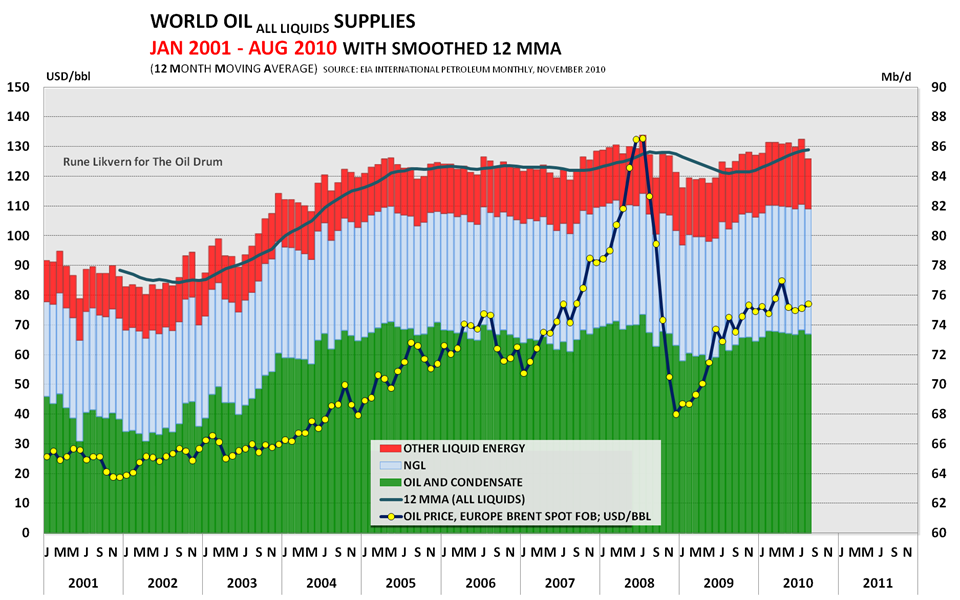
My post is mainly an update to Global Oil Supplies as Reported by EIA's International Petroleum Monthly for September 2010, based on data which the EIA reported in the past few days. I will also briefly present updated information regarding OECD and Non OECD oil supplies/consumption.

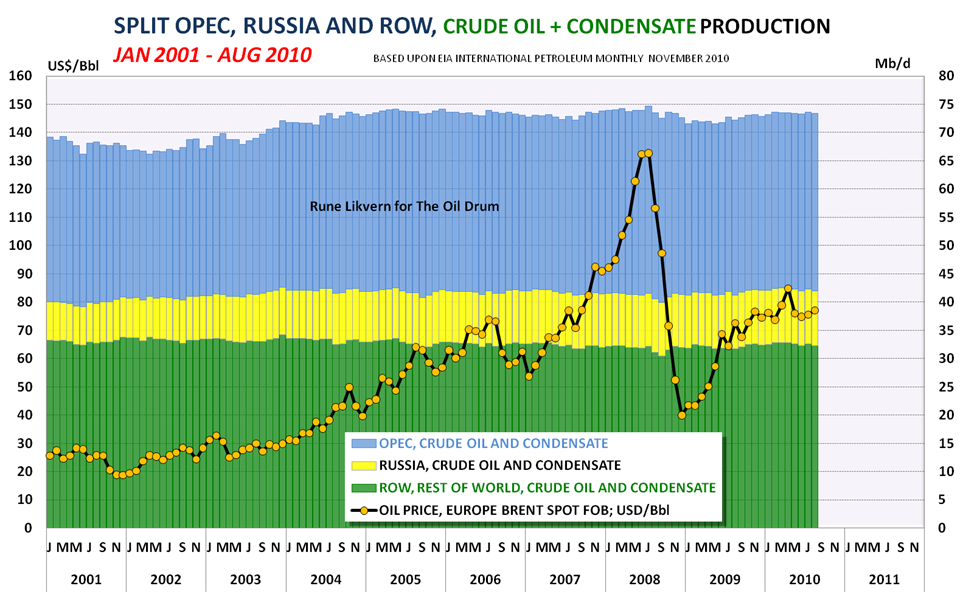
The stacked columns show crude oil and condensates supplies split among OPEC, Russia and ROW (Rest Of World which also includes OECD), from January 2001 through August 2010. The development in the average monthly oil price is plotted on the left hand y-axis. Note that world oil production has been on a plateau, from late 2004 to the present, with a small dip when prices dropped in late 2008 to early 2009. This graph considers crude and condensate only, excluding natural gas liquids and other forms of liquid energy, such as biofuels.
DISCLAIMER: The author holds no positions in the oil/energy market that may be affected by the content of this post.
NOTE: Scaling varies from chart to chart and some charts are not zero scaled. Labels indicate whether graphs are on an "all liquids" or "crude and condensate" basis.

Figure 01: The stacked columns in the diagram above show development in global supplies of crude oil and condensate, NGL and other liquid energy from January 2001 through August 2010. The development in the average monthly oil price is plotted on the left hand y-axis. NOTE: Diagrams based upon EIA data may be subject to future revisions.

Figure 02: The stacked columns shows crude oil and condensates supplies split among OPEC, Russia and ROW (Rest Of World; which also includes OECD), from January 2001 and as of August 2010. The development in the average monthly oil price is plotted on the left hand y-axis. Over the period covered by the graph (2001 to present), growth in Non OPEC supplies have primarily come from Russia. Oil supplies from the "Rest of World" (ROW) have not grown.
The long bumpy plateau from late 2004 to the present illustrates that huge swings in oil prices in recent years have had only a small impact on crude oil and condensate supplies.
EIA in their STEO (Short Term Energy Outlook) for November 2010 projected a slight decline in OECD and Russian petroleum supplies from 2010 to 2011, but a smaller decline than in the September STEO had shown. Under most circumstances, it could be expected that most of these declines would be offset by growth in OPEC supplies.

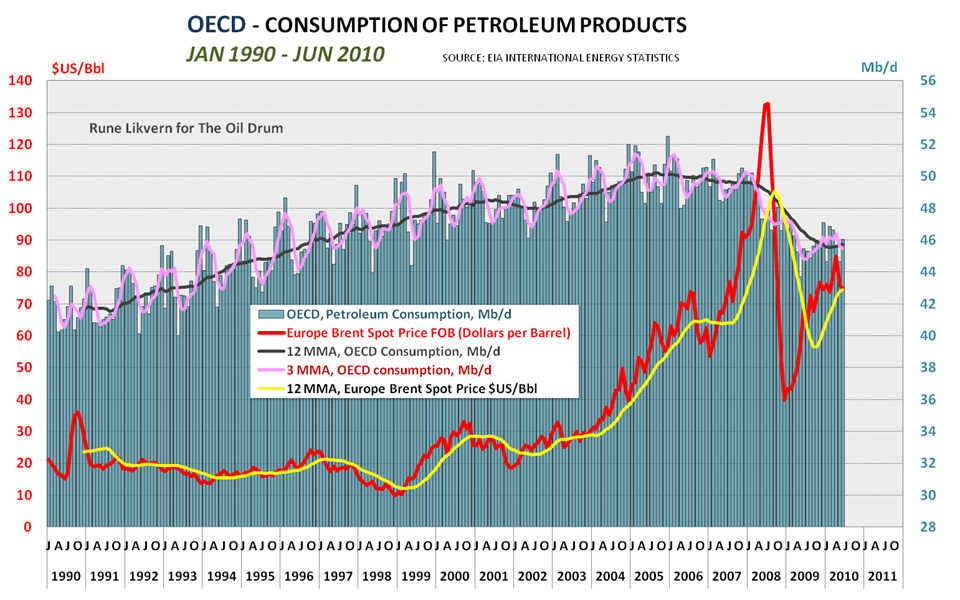
Figure 03: The diagram above shows development in OECD consumption of petroleum products between January 1990 and June 2010 together with the development in the oil price. In the recent months, petroleum consumption within OECD has seen some growth and this coincides with the recent growth in the oil price.

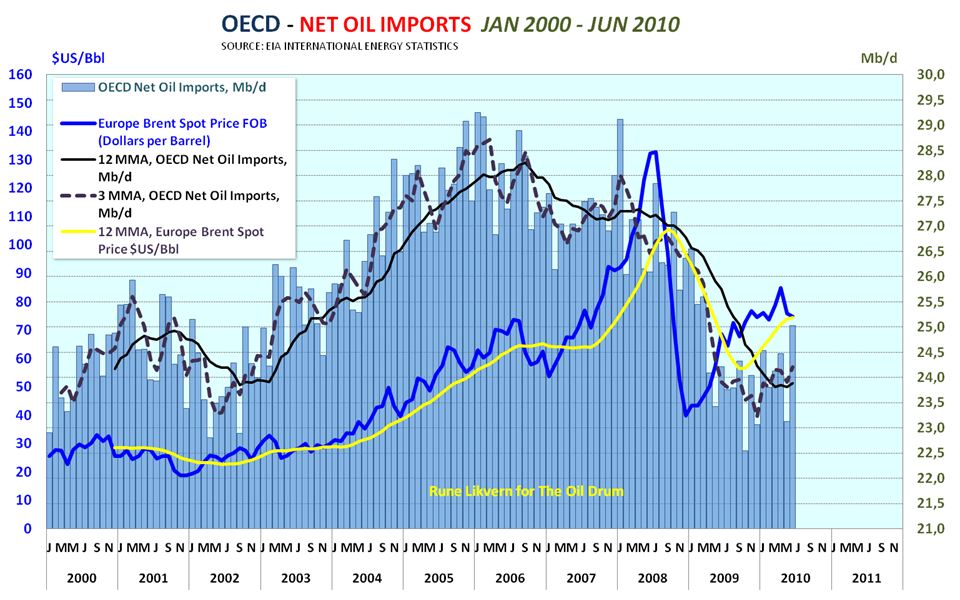
Figure 04: The diagram shows development in net oil imports for OECD from January 2000 through June 2010. This diagram shows that the recent oil price growth happened as OECD again started increasing oil imports. This is one of the indicators suggesting that the oil price now has strong support based on fundamentals.

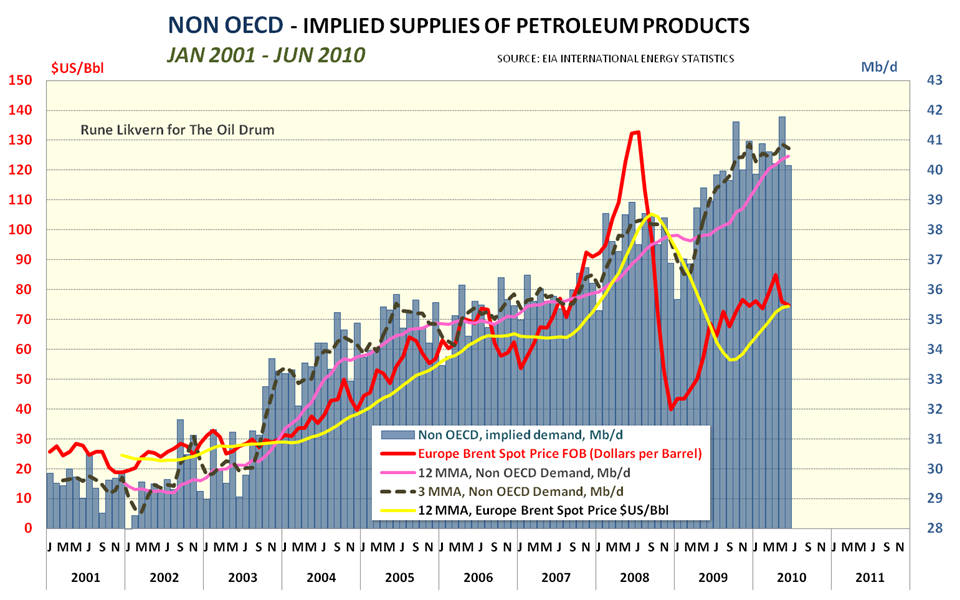
Figure 05: The above diagram shows implied demand for liquid energy from Non OECD countries from January 2001 through June 2010. (I describe it as implied demand as the diagram shows the difference between total global supplies of liquid energy and OECD supplies (production + net imports)). Recently, demand for petroleum products from Non OECD seems to have leveled out as illustrated by the 3 MMA (3 Month Moving Average). (I use the 3MMA both to more easily identify seasonal variations and also to act as a “pilot” for trends over several months.)

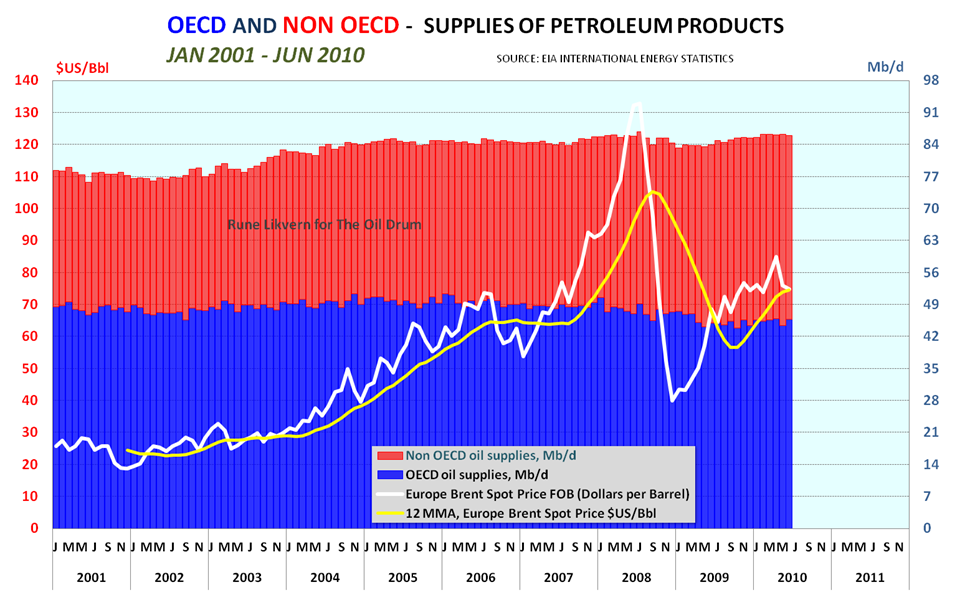
Figure 06: The stacked columns show the split between OECD and Non OECD supplies of liquid energy from January 2001 through June 2010. The average monthly oil price is also plotted on the left hand y-axis. If we start with Figure 05 there clearly was a strong growth in demand from Non OECD starting early in 2009. From the diagram it shows the price grew with the demand growth from Non OECD. OECD demand was tanking at the time. To me this is a strong indicator that price in this period was driven by Non OECD demand.
As OECD production continues to decline, a growing need for imports into OECD (ref figure 04 in this post) is expected to add upward pressure to the oil price. Oil imports into OECD will normally tend to be higher during the heating season (winter in the Northern Hemisphere) and this suggests an upward pressure on the oil price in the months ahead.
Within a couple of weeks, I hope to post here on TOD an in-depth analysis that shows that at the current costs (as of first half of 2010), one can expect that in the U. S., an average annual oil price of $80 - 85/Bbl (Brent spot) results in GDP exclusive of energy expenditures that does not grow. This means that the present growth in U.S. GDP covers growing energy expenditures. Energy expenditures are costs for petroleum products, plus energy resources for non energy use (asphalt, coke, petrochemical feedstock etc.), natural gas and electricity).

Figure 07: The stacked columns show each OPEC member’s crude oil supplies and OPEC’s supplies of lease condensates and NGLs from January 2001 through August 2010. The average monthly oil price is also plotted on the left hand y-axis. The recent data from EIA shows a small growth in supplies of crude oil, condensates and NGLs from OPEC. (Lease condensates and NGLs are presently not part of OPEC's quota arrangements.)
To me, the recent growth in the oil price (adjusted for fluctuations in the value of the US Dollar) is a signal calling upon increased crude oil deliveries from OPEC.

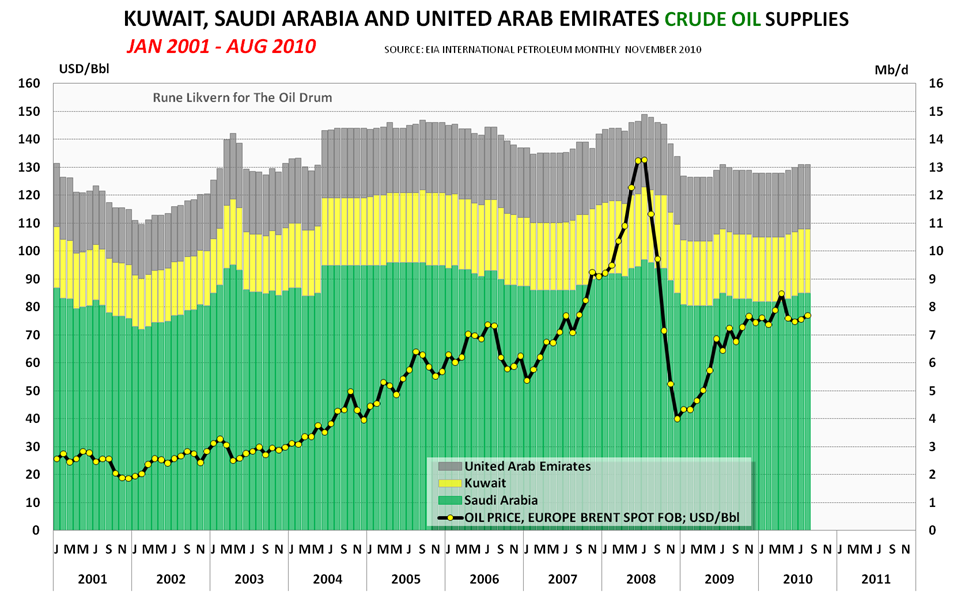
Figure 08: The diagram above shows crude oil supplies from January 2001 through August 2010 for Kuwait, Saudi Arabia and United Arab Emirates. I believe most of present global spare marketable crude oil capacity is to be found amongst the 3 exporters presented above. Saudi Arabia increased their crude oil supplies by 300 kb/d between April and July of this year. It is not clear whether one can conclude that this caused some retreat in the oil price, but it is an interesting coincidence.

Figure 09: The stacked columns shows development in crude oil supplies from the 9 other OPEC members. The average monthly oil price is plotted on the left hand y-axis. Total crude oil supply from the 9 OPEC members above have remained relatively high and flat during the recent months, suggesting that these countries are pumping at maximum levels, regardless of price.
In summary, November's International Petroleum Monthly supports a continuation of the trends I had noted in my earlier post. In other words, world economies are still growing, putting more pressures on oil prices. By the end of 2011, my earlier analysis showed that the OPEC spare supply margin may be depleted. The next few months may be interesting ones!
SOURCES:
[1] EIA, INTERNATIONAL PETROLEUM MONTHLY, NOVEMBER 2010
[2] EIA, INTERNATIONAL ENERGY STATISTICS
[3] EIA, SHORT TERM ENERGY OUTLOOK, NOVEMBER 2010

Exploitation of oil in Italy

The presence and exploitation of oil in Italy is certainly very ancient and dates back at least to Roman times, because the demonstrations were in the Apennines natural oil used as fuel and waterproofing.  
The draw held at the end of a regular production of oil began in 1860 using several wells in the vicinity of the natural manifestations of leakage in the Northern Apennines.
But the complex geology and stratigraphy of this area of ​​the Apennines had not yet been fully studied and were still many unresolved issues, oil exploration then concentrated Emiliano Apennines, where they appear in the scaly clays (Liguride), did not great progress and modest productivity gains were achieved with the improvement of the extraction technique than with the identification and exploitation of new deposits. In fact there is an increase in tons of oil extracted by passing 1000 tons in 1891 to 10,000 in 1911 and 20,000 in '31.  

The first major conceptual breakthrough in the structural geological situation occurred with Caesar Leek, although the exploration techniques did not allow an objective of his theories. In fact, speculated that the scaly clays could be the "rock" but they had needed to be a good permeability reservoir (see oil) from which to extract the oil.Near the Italian production of oil from 1944 to 1984 in the TOE (tonnes of oil equivalent), in the field of Narcissus with relative seismic section (Pieri, Oil Zanichelli Ed).


Mattei, Agip leadership.

Only in 1940 was available seismic reflection survey (research method that uses the compression waves, earthquakes see) and in 1944 came the first important discovery of the deposit Caviaga (near Lodi, has 46 producing wells that extract pure methane for 97% and containing 2.2% for the higher hydrocarbons and the reservoir was discovered in the sands of the Miocene Pliocene on the substrate, the porosity of the reservoir is 29% with a maximum thickness of 300 meters. The depth of extraction is of 1404 meters. 

The trap is a structural one, namely an anticline), whose reserves of 12 billion cubic meters of methane demonstrated the economic potential of this new type of research. From 1944 to 1987 were drilled exploratory wells in Italy about 1800 at an average depth of 3000 meters, which have identified about 300 fields.There are many areas of interest such as oil in the Po Valley Italy, studied and used mostly by Agip (Italian General Petroleum Company), under the leadership of E. Mattei in 1953 he obtained the exclusive right to the whole area and the Po Valley Veneta.  
This allowed him to make an exploration of organic and represents the best example of a portion of territory in which the advancement of knowledge and stratigraphic geology is entirely due to oil exploration.  
Within this area (about 52,000 sq km, 1 / 6 of the whole Italian territory) have identified several interesting structures as clastic and carbonate rock deposits with structural traps, stratigraphic and mixed (see petroleum).

The oil and gas Po have different origins

The oil and gas Po have different origins, in fact most of the deposits in the Plio-Pleistocene reservoirs, consisting of methane gas, like that of Ravenna (discovered in 1952 with 30 producing wells that extract natural gas with 99.5% traces of nitrogen and higher hydrocarbons, the depth of extraction is between 1250 and 1960 meters and the trap is a structural joint, particularly a synsedimentary anticline with a covering of clay of the same age) or to Serigne (discovered in 1954 11 wells that extract natural gas 99.2% pure with traces of higher hydrocarbons and nitrogen and the depth of extraction is of 1305 meters, the type of stratigraphic trap is the erosion of the cover of the Messinian) is deemed to have an origin biogenetic .  
The clay of these sequences are in fact formed by alternating layers of clay and sandy soils that contain organic matter with a predominantly terrestrial plant and then, under conditions of rapid accumulation occurs resulting in the formation of gas levels
in the drainage of clay and gas levels sandy. So biogenic gas could be formed in large quantities and form a reservoir space.
Another source is the gas with a higher oil content of the order of 3-10%, the latter fact comes from the kerogen of great depth (see petroleum), and in many cases the oil is able to migrate through the fracture zones Pliocene and Quaternary reaching the reservoir, then mixed with the gas diagenetic of recent origin.  

This type of situation is found in Cavone deposit (discovered in 1973 near Modena, produces oil at 24.3 API, the depth of extraction is about 3000 meters, the trap is made of a structural anticline) or in Malossa (discovered in 1973 always produces 79.08% pure methane with higher hydrocarbons, and condensed to 53 API, and due to the fracturing of the cover gas is also filtered in the above sequences. 
The depth of extraction is 5830 meters, and the trap is structural, in particular a faulted anticline that has been tettonizzata at the end of the Miocene). Alongside a section of the field of Gela, from Pieri 1969. Under the oil platform in the Perla field, off the coast of Gela, the old photographic documentation, ENI.


Great importance of Villafortuna

Of great importance is the giant Villafortuna, (near Novara, discovered in 1984 and produces oil at 34 API, from a depth between 4600 and 6200 meters), which happens to be the largest oilfield in continental Europe and produces 61,000 barrels per day (1 barrel is 158.76 liters).Even in the Northern Apennines was resumed exploration with the identification of some deposits, small, but interesting in structural traps located in the outer elements of the chain, which are located in the Marche and in the eastern Adriatic Sea. Even in this case the oil has different origins: a first group of gas fields has fields with reservoir lithology sandy Pliocene, while a second group, containing oil and gas, but has sandy Miocene reservoir lithology with sup. and Lower Pliocene. (Deposits and Busseto Cortemaggiore). A third group of deposits, containing oil and gas, Jurassic carbonate reservoir has cretaceci Cretaceous or Eocene (Marche fields of Santa Maria beach, St. George's sea bream, Dora

Italy has modest reserves of natural gas

Italy has modest reserves of natural gas, especially in the Po Valley, with which in 2009 covered about 15% of national demand.
History [edit]

The first extraction of natural gas in Italy in 1938 was made by Podenzano.

In 1939 was built the first pipeline to transport gas between Pietramala and Florence. In 1942-'43 was built the first pipeline between Lodi and Milan Salsomaggiore.

In 1944 it was discovered the giant Caviaga, then the largest discovered in Western Europe.

In 1948 it was discovered the field of Ripalta.

Between 1946 and 1950 Italian production went from 20 to 305 million cubic meters between 1949 and 1951 the distribution network was increased from 354 to 1266 km.

In 1952 it was discovered the field of Ravenna, at 1250-1960 m depth (30 production wells) in 1954 to Serigne, at 1305 meters (11 active wells).

In 1960 it was discovered the field of Gagliano, at 2000 meters. In 1973 the mine was discovered Malossa, at 5800 meters.

Among the nineties and 2000 were launched new wells in the Adriatic.

The oil in Italy

The oil in Italy. 

Oil wells and gas in Italy are small, highly fragmented and often located at great depths, or offshore, and this made it difficult to both their location and their exploitation.  
Italy is the 49 th largest oil producer in the world. 
The oil fields are most important in Italy in Sicily and in its immediate offshore, in particular the field of Ragusa (1500 meters) or that of Gela (discovered in 1956, has similar characteristics to that of Dubrovnik and is 3500 meters deep) and that of Gagliano Castelferrato (discovered in 1960, produces gas and is located about 2000 meters deep).  
Besides these there are other fields in the east and Western Europe. There are also one of the most important ones from the Val d'Agri, Basilicata, and the Port of Ravenna in the Adriatic Orsini. 

The search for oil continues today, with oil production of around 80,000 barrels per day, while the gas fields is about 15 billion cubic meters. The peak of oil production in Italy was reached in 1997, and the current rate of depletion was 3.1%.The national production represents about 7% of our total oil consumption, the remaining 93% is imported from abroad, therefore, the Italian production, then, is 1% dellla world production, with the remaining reserves, about 1 billion barrels, representing 0.1% of world reserves of crude oil.

The environmental impact of oil extraction. 

The extraction of oil has a high environmental impact of extraction is normal activity, which provides seismic exploration, drilling and above all highly polluting waste, is the inevitable and unfortunately common accidents. 
The oil extraction is a very expensive operation which has negative consequences for the environment: research offshore dredging disturb the marine environment and damaging the seabed rich in algae in the marine food chain core have a serious impact on the environment.It is therefore important that each of us choose products made without the use of oil (glass, jute, aluminum instead of plastic) and adopts a positive approach nela mobility (LPG, CNG, electric).

Oil wells and gas in Italy are small

Oil wells and gas in Italy are small, highly fragmented and often located at great depths, or offshore, and this made ​​it difficult to both their location and their exploitation.

The oil fields are most important in Italy in Sicily and in its immediate offshore, in particular the field of Ragusa (1500 meters) or that of Gela (discovered in 1956, has similar characteristics to that of Dubrovnik and is 3500 meters deep) and that of Gagliano Castelferrato (discovered in 1960, produces gas and is located about 2000 meters deep).

Besides these there are other fields in the east and Western Europe. There are also one of the most important ones from the Val d'Agri, Basilicata, and the Port of Ravenna in the Adriatic Orsini.

Trevisan who live at the foot of Montello

Trevisan who live at the foot of Montello, including Giaveri Nervesa Spresiano and Arcade, have under their feet one of Italy's strategic reserves, to Collalto.
It is not only a cultural field (here, in Collalto, John wrote the House of Etiquette "Over de 'costumes," published in 1558, and the Earl of Collalto was in the same year the subject of poems by Gaspara Print) but is also a field in the literal sense of an Edison storage.  
Among the Stogit (ENI), the largest European companies storage, and Edison, Italy is the EU country with the "store" larger than methane.
Warehouses, storage facilities ie: old gas fields which, after being emptied, are re-used as reservoirs hidden and strategic.  

After all, the old fields are watertight, have seen that the methane stored for millions of years, and are well infrastructured: when the gas is extracted, there came the pipes to bring natural gas pipelines dress.  
Today those same pipes carry the gas underground, when demand is low and when demand for natural gas riestraggono is sky or - as happens these days - when it inflames the "gastritis" between Russia and Ukraine.
The Italian system of storage of methane can count, January 5 at 6 am, on a stock of 6.78 billion cubic meters (since Stogit), representing 80% of what there was in early November when ended up filling the reserve. It's enough to withstand a great international crisis.
On 22 December, when the gas pipeline from Russia to be operating below full capacity, there were still 7.38 billion cubic meters (87.7% of stock compared to November), with a forecast of 31 March with inventory for 2, 4 billion cubic meters (28.6% compared to November last year).
These deposits Invisible Eni and Edison are working on behalf of the market. The gas companies buy natural gas when it costs little (for example, in the summer when demand cools low prices), store it in Italian warehouses, and then ordered Eni to put it back on the market when the pipelines are so full that no sufficient to meet winter demand. The service is paid with the tariffs set by the energy, the most reasonable rates in Europe.
Inventories of natural gas owned by the companies and operators are not all available reserves. An additional fee of methane is reserved for the State, that the reserve "strategic" fixed by law. Finally there is the so-called cushion gas, that is what it takes to create the pressure needed to push out the methane gas-cushion is untouchable, because if it were an object extracted the tank would become useless and wasted.
Gas companies to serve much the stocks: the Edison, the Gaz de France, the Hera, the Northsurn, the Sorgenia, Ital Gas Storage, Gas Plus, the Geo Stock, Enel, Acea, The Blugas have asked to make deposits in the old empty deposits of Bagnolo Mella (Brescia), Cornegliano (Lodi), Cugno Pizzuta The Millstones and Serra (Matera), Poggiofiorito (Chieti), Rivara (Modena), and Romanengo Voltido (Cremona ), St. Benedict and Verdicchio (Ascoli), San Potito (Ravenna), Sinarca (CB).
Italy is more dependent than other methane, which accounts for 38% of energy requirements and has passed the oil between the sources. The reason is simple. The new power plants with very high efficiency and low pollution burning methane. Under the direction of the Ministry of Economic Development Energy, in 2007 (the 2008 data are still being processed), Italy consumed 84.89 billion cubic meters and 34.29 have been burned by power plants (households, commerce and service sectors I have burned 28 billion and 19 billion industry). By comparison, in 2003 the central burned 25.7 billion cubic meters while the families were first item of consumer and commercial applications. (J.G.)

Sustainable biofuels to the EU

* The first mechanisms for sustainable biofuels to the EU level are approved
      
published on 19/07/2011

Biofuels can be an environmentally friendly solution to replace fossil fuels.  

However, we must ensure that rainforests and carbon-rich peatlands do not become oil palm plantations and sugar cane.  
We must also ensure that biofuels provide, compared to fossil fuels, real savings of greenhouse gas emissions. To this end, the sustainability of biofuels must be controlled either by the Member States, either through voluntary mechanisms subject to the approval of the European Commission. Today, the Commission has identified seven of these voluntary mechanisms: ISCC, Bonsucro U.S., EU RTRS RED, RED U.S. RSB, 2BSvs, and RSBA Greenergy. This approval is directly applicable in all 27 EU Member States.
The Commissioner for Energy, Mr Günther Oettinger, said: "We must ensure that the entire biofuel production and the corresponding supply chain is sustainable. That's why we set the standards for sustainability of the world's most demanding.  

Mechanisms recognized today at the EU level is a good example of a reliable and transparent system that ensures compliance with these standards.
In order to receive public support or recognition for the achievement of national mandatory renewable energy, biofuels used in the EU, whether from local production and imported must meet sustainability criteria. They aim to prevent areas of high biodiversity value or with high stocks of carbon are converted into areas producing raw materials for the production of biofuels. In practice this means that biofuels produced from crops on land previously occupied by tropical forest or natural grassland with a unique ecosystem can not be considered sustainable. In addition, emissions of greenhouse gases over the entire production chain must be less than at least 35% to those in the chain of production of fossil fuels. This threshold will be raised gradually.
ContextThe EU has set a target a share of at least 10% of renewables in transport by 2020. Where biofuels are used to achieve this objective, they must meet a set of requirements for sustainability. Thus, biofuels can be produced in areas of high biodiversity value, such as protected areas or in areas with high stocks of carbon, such as forests and bogs.
Companies can choose to demonstrate their compliance with sustainability requirements as part of national or by joining a voluntary recognition by the Commission.
When the Commission has audited the depth of a mechanism with regard to the durability requirements and is satisfied that it adequately covers the requirements of sustainability set out in the Energy Directive renouvelables1, it will grant its approval for a five years.

These mechanisms control the place and manner of production of biofuels. If the rules are complied with a voluntary mechanism, this mechanism may issue a certificate for the product in question.After a thorough evaluation conducted by the Commission, and various improvements, the following mechanisms have been recognized:
- ISCC (mechanism funded German public for all types of biofuels);- U.S. Bonsucro (initiative for biofuels made from sugar cane, focusing on Brazil);- RTRS EU RED (initiative for soy-based biofuels, focusing on Argentina and Brazil);- RSB EU RED (initiative on all types of biofuels);- 2BSvs (mechanism developed by French producers and covering all types of biofuels);RBSA (mechanism established by the company Abengoa to its supply chain);- Greenergy (mechanism established by the company Greenergy for Brazilian ethanol made from sugar cane).The Commission is currently discussing with officials of other mechanisms voluntary opportunities to improve their functioning in order to apply sustainability requirements for biofuels.
Origin: European Commission Press Release

GDF SUEZ oil exploration

GDF SUEZ announces two important milestones in the development of its asset portfolio of exploration and production. These operations are located in one area in a mature Norway and the other in a promising region in Asia.
GDF SUEZ has thus acquire an additional 20% stake in gas field offshore Njord Noatun discovery and Norway from ExxonMobil Exploration & Production Norway AS. GDF SUEZ E & P Norge AS becomes the largest shareholder with 40% of this license, together with Statoil (20%, operator), E. ON Ruhrgas (30%), Faroe Petroleum (7.5%) and VNG (2, 5%).
At the same time, GDF SUEZ, with its partner Eni Indonesia (operator's license Muara Bakau with a 55% stake) announced a discovery in the North-East gas field Jangkrik on the licensing of offshore Muara Bakau, Indonesia.  

This result follows the success of two exploration wells and appraisal wells completed in 2009 and 2010 on the field of Jangkrik.
According to Jean-Marie Dauger, Executive Vice President of GDF SUEZ in charge of Global Gas & LNG: "These two transactions illustrate well the strategy E & P of GDF SUEZ and its successful implementation: a balanced portfolio with a presence high in mature areas such as Njord Norway, and exploration activity in new regions such as Indonesia. "
The Njord area offshore Norway experienced strong activity. The field of North-West Flank, which is part of the license of Njord, is currently being drilled from the platform Njord and fast track development project field Hyme (ex-Gygrid), recently approved by the Ministry of Petroleum and Energy, provides a connection to the Njord infrastructure, where the gas will be processed. The project started production on the low pressure Njord field in 2013 will increase the recovery rate and the life of the field, in production since 1997.  

Operating in the license since late 2000, GDF SUEZ would also accelerate the development of other discoveries in the region, to extend the lifetime of the Njord platform to serve as a hub for the area. The transaction is subject to approval by Norwegian authorities.
In Indonesia, GDF SUEZ has entered the offshore exploration license in Muara Bakau in September 2009, taking a 45%. This license is located in the eastern basin Kutei, leaving the Mahakam Delta, the largest river in the eastern part of the island of Borneo (East Kalimantan).The results of this exploratory wells indicate the presence of gas over 60 meters thick net sand in tanks of high quality dating Pliocene and Miocene epochs. During production test, the well produced gas with a high quality flow forced the well of 0.87 million m3 / d. The gas produced will be sent to the Bontang LNG plant.

Present in 16 countries, GDF SUEZ E & P has developed a balanced portfolio through targeted acquisitions and being operator licenses, to provide cash flow and resources to the Group. December 31, 2010, GDF SUEZ holds 362 licenses, of which 206 (57%) as an operator. The reserves were 815 mboe and total production of 51.2 Mboe (74% gas - 26% oil).

News to trade oil for binary options

News to trade oil for binary options

Note also that for oil, a weekly publication of the weekly inventory report from the U.S. Department of Energy is one of the most volatile and therefore more attractive to sell.  

This report is published every Wednesday at 14.30 but is available in preview on the website of U.S. Department of Energy.  
Be careful though as this report covers both the oil, but diesel and other petroleum products.

In this report, also included on many sites dedicated to oil, there are figures on oil stocks in different regions of the United States with each of these predictions of changes in stocks. These weekly reports are often shelled and analyzed by specialists in emerging future trends. In addition, the Department of Energy publishes reports by filing requests and imports of oil and its derivatives which are also of great use when the oil trade due to binary options.


In general, the more you will be informed of this, the more you can effectively binary options trader on oil by using the volatility that followed the publication of figures to make a profit on the sale. You just then, to get started and to open the eye to identify key moments in the trading of oil in binary options.

invents the Saudi oil reserves there are not

Peak oil could be much closer than previously thought, or rather may already be safely done.

Wikileaks has published some documents to prove it a habit of cheating Saudi emirs of which was suspected for years in the OPEC.
In Saudi Arabia it would deliberately inflated by more than 40% oil capacity inventing the beauty of 300 billion barrels that do not exist.

A little vice, that of the Saudi oil industry, which has two strong implications: one, if the Saudi oil reserves are not sufficient to support prices, it is likely a jump in crude oil prices, making it more expensive than the cost of energy bills in the West .
Secondly, the scarcity of oil reserves could redesign some balance of power nell'instabile Middle East chessboard.

What is certain is that the end of the civilization of oil is approaching with great strides and the search for alternatives should be strongly encouraged, not opposed.

The presence and exploitation of oil in Italy

The presence and exploitation of oil in Italy is certainly very ancient and dates back at least to Roman times, because natural events in the Apennines oil were used as fuel and waterproofing. The draw held at the end of a regular production of oil began in 1860 using a number of wells in the vicinity of the natural manifestations of leakage in the Northern Apennines.

But the complex stratigraphy and geology of this area of the Apennines had not yet been fully studied and many issues were still unresolved, then the search for oil, concentrated Emiliano Apennines, where they appear in the scaly clays (Liguride), did not great advances in productivity and modest increases were obtained with improved extraction technique rather than with the identification and exploitation of new deposits. In fact there is an increase in tons of oil extracted by passing 1000 tons in 1891 to 10,000 in 1911 and 20,000 in '31. The first important conceptual breakthrough in structural geological situation occurred with Cesare Porro, even if the techniques did not allow an objective exploration of his theories. In fact, speculated that the scaly clays could be the "rock" but they had needed to be a good permeability reservoir (see oil) from which to extract the petrolio.a.

Italy is not 'the Cinderella of Europe's oil and gas wealth

  Italy is not 'the Cinderella of Europe's oil and gas wealth.  
Italy occupies third place among the other hand, producers of oil in Western Europe after Britain and Norway, with 330,000 barrels of oil equivalent per day (boe). Our country has proven reserves of oil and gas amounted to 1.9 billion barrels of oil equivalent (boe), while those yet to be discovered are measured from a minimum of 1.2 billion and 4 billion boe.  
The report highlights a dell'Assomineraria, the association of companies in the field of exploration and production of hydrocarbons. To confirm the potential 'national association announces that the British Northern Petroleum has received a preliminary eight new oil exploration concessions in Italy.  
These are six offshore concessions, four of them in the Strait of Sicily and Southern Italy in the Adriatic two and two on land, in the Po Valley: Longastrino near Bologna and Gattinara in the province of Novara. 
 The company now automatically boots' environmental impact studies for the final go-ahead operations.Despite these potential ', the domestic production of gas and' dropped in 2005 to 12 billion cubic meters per year compared to 20 billion cubic meters a decade ago, when methane covering 37.4% of national consumption against 'current 15%. Dell'Assomineraria estimates, at this rate, in 2010 the domestic production of gas will go down 'to 5 billion cubic meters a year, covering only 5% of consumption compared to a growth in demand that led to 84 million cubic meters of national demand.  
The Assomineraria proposes to bring into production of reserves already 'identified and in areas outside the North Adriatic Sea, about 700 million barrels of oil equivalent. ''Our country still has a considerable potential for hydrocarbon production and this could easily increase, doubling in a few years, if you were a more 'courageous to facilitate the development of fields already' discovered and to encourage a ' exploration languished for many years''explains the Assciazione. For example, there are 34 billion cubic meters of gas have already 'discovered in the northern Adriatic, whose development and' locked up in 1995 to fears of environmental impact, in particular related to subsidence.

The post-petroleum paradigm

The post-petroleum paradigm
It is hard to imagine a world without oil in detail, but some aspects of the post-petroleum paradigm can be predicted with some degree of safety.
Should be used all economically viable sources of energy, but replace the oil in its great versatility probably will not be completely possible. Replace the role of oil and gas together in agricultural production will be the biggest problem, and could be a problem not completely solved.
The world's population will be made compatible with smaller quantities of food by means of a reduction. Pimentel and Pimentel (1996) state: "... the nations of the world must develop a plan to reduce global population by nearly six billion today [in 1996, the estimated world population now amounts to 6,909,980,739 people - NDT] about two billion [... still too many - NDT]. If man will not be able to control the size of their population numbers, will take care of nature. "Since the stop and turn back the train of population growth is something that can only be done gradually, this is a process that should be started now (Cohen, 1995). If this is not done, it is likely to occur on a large scale famine. "[Since Cohen argued this thesis, others have already passed 16 years, approximately 1,010,729,471 people added to global population: nothing has been done, separately discuss - NDT]
The excellent personal mobility of those people now fortunate enough to enjoy the use of automobiles and airplanes will be greatly reduced.
The lifestyle of energy-consuming nations should be facilitated. The nations that do not enjoy the possibility of such energy use have less to lose and could not be forced to live like big changes.
The attention of society as a whole should be given much more towards ensuring the foundations of existence than it does today, especially in affluent societies where abundance is considered to be guaranteed and the good life lived accordingly.
Scientists, economists, sociologists and political scientists are increasingly concerned about the effects of the oil. Mitigate the social and economic strains have the highest priority.

The oil in Italy.

The oil in Italy.

Oil wells and gas in Italy are small, highly fragmented and often located at great depths, or offshore, and this made ​​it difficult to both their location and their exploitation. Italy is the 49 th largest oil producer in the world.
The oil fields are most important in Italy in Sicily and in its immediate offshore, in particular the field of Ragusa (1500 meters) or to Gela (discovered in 1956, has similar characteristics to that of Dubrovnik and is 3500 meters deep) and that of Gagliano Castelferrato (discovered in 1960, produces gas and is located about 2000 meters deep). Besides these there are other fields in the east and Western Europe. There are also one of the most important ones from the Val d'Agri in Basilicata, and the Port of Ravenna in the Adriatic Orsini.
The search for oil continues today, with oil production of around 80,000 barrels per day, while the gas fields is about 15 billion cubic meters. The peak of oil production in Italy was reached in 1997, and the current rate of depletion was 3.1%.
Domestic production accounts for about 7% of our total oil consumption, the remaining 93% is imported from abroad, therefore, the Italian production, then, is 1% dellla world production, with the remaining reserves, about 1 billion barrels, representing 0.1% of world reserves of crude oil.

Soon to Come, Storing Renewable Energy for Later Use

Soon to Come, Storing Renewable Energy for Later Use

energy storage typesCurrently, the amount of electricity produced is restricted according to the production capability of the power grid. During peak usage times, the grid is taxed to the max, making it more vulnerable to failure. This supply versus demand system supports the high energy costs that we as consumers are faced with. What if energy could be caged and stored for future use?
The technology is already in place for energy storage, but currently is an expensive process. The hope is that the practice will grow in efficiency and eventually be in widespread operation.
The process works by storing the unused electricity made from renewable sources such as solar energy and wind during off-peak times, and then supplementing the power grid during peak usage time. According to Lawrence Gelbien, vice president of technology at the utility company NStar “storage units could be deployed in place of installing more ‘wires and poles’ in a place that isn’t served with enough electricity to meet demand for only a few days of the year. Because storage devices are movable, they could be redeployed in other places after a few years as the need arises.” (Energy Storage Coming to a Grid Near You, CNet News.com.)
Also under the umbrella of electrical storage for household consumption is storing it and converting it to fuel for transportation. With the recent high fuel prices, the government is finally taking a closer look at alternatives such as energy storage. Hybrid electric vehicles (HEV’s) can use the high energy of stored electrical energy for fuel. In order for these vehicles to become more efficient and affordable for all Americans, energy storage must become more efficient and practical.
The encouraging aspect to our energy problems is that our government is finally forced to allocate more resources toward developing new technologies. Hopefully, this will lead to more renewable energy resources and more eco-friendly options.